Clinic appointments are mandatory — please book at least 2 days in advance. Book online or call +91 85888 99099
Angioplasty in Vaishali & East Delhi · 01 / 05

Complex & High-Risk
Angioplasty

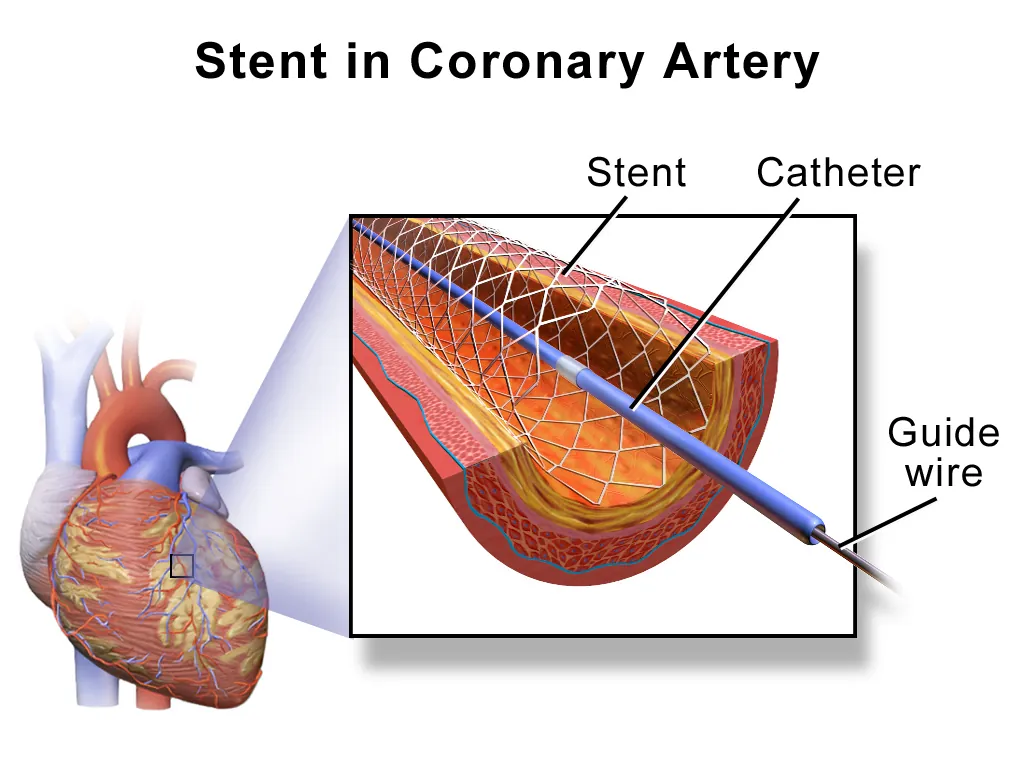
Angioplasty opens narrowed or blocked heart arteries using a thin tube (catheter) passed through the wrist or groin. A stent is usually placed to keep the artery open. Dr. Minocha has performed 9,000+ angioplasties and 20,000+ angiograms, including in heart attacks, multivessel disease and high-risk patients.

Covered on this page

  • Coronary Angiography
  • Coronary Angioplasty & Stenting
  • Primary Angioplasty for Heart Attack
  • Multivessel & High-Risk PCI
Illustration of coronary angioplasty: a balloon opens a blocked heart artery and a stent keeps it open
Illustration: Blausen.com staff (2014), “Medical gallery of Blausen Medical 2014”, WikiJournal of Medicine — CC BY 3.0, via Wikimedia Commons.

Procedures, explained simply.

Diagnosis

Coronary Angiography

What it is

An X-ray test of the heart arteries. A contrast dye is injected through a thin catheter to show exactly where the arteries are narrowed or blocked.

Why it is done

To find the cause of chest pain, check an abnormal stress test or CT result, or assess the heart after a heart attack — and to plan the right treatment.

PCI

Coronary Angioplasty & Stenting

What it is

A tiny balloon is inflated inside the narrowed artery to widen it. A drug-eluting stent — a small mesh tube coated with medicine — is then placed to keep the artery open.

Why it is done

To relieve chest pain (angina) and improve blood flow to the heart when medicines alone are not enough or the blockage is serious.

STEMI

Primary Angioplasty for Heart Attack

What it is

Emergency angioplasty to open the fully blocked artery during a major heart attack, done as quickly as possible after arrival at the hospital.

Why it is done

Every minute counts — opening the artery early saves heart muscle and lives. Dr. Minocha set up the STEMI heart-attack care pathway at Max Vaishali.

Complex PCI

Multivessel & High-Risk PCI

What it is

Angioplasty when more than one artery is blocked, or in patients with weak heart pumping, diabetes, kidney disease or older age.

Why it is done

Careful planning, imaging and a discussion with the heart team help decide between angioplasty and bypass surgery for the safest result.

Who may need it

Your doctor may suggest this if you have:

  • Chest pain or pressure on walking or climbing stairs (angina)
  • An abnormal TMT / stress test or CT coronary angiography
  • A heart attack — now or in the past
  • Breathlessness caused by reduced blood supply to the heart
  • Blockages found in more than one artery

How it is done.

  1. Assessment

    Consultation, ECG, echo and blood tests. Angiography shows where the blockages are.

  2. Preparation

    The wrist or groin is cleaned and numbed with a local injection.

  3. Opening the artery

    A fine wire crosses the blockage, a balloon widens it and a stent is placed.

  4. Recovery

    You are monitored for a few hours. Most patients walk the same or next day.

Before the procedure

  • Share a list of all your medicines — especially blood thinners and diabetes medicines
  • Tell the team about any allergy, especially to contrast dye or iodine
  • A kidney function blood test is usually needed
  • Do not eat or drink for a few hours before, as advised (usually 4–6 hours)
  • Come with a family member and bring all your old reports

After & recovery

  • Take blood-thinning medicines exactly as prescribed — never stop them on your own
  • Avoid lifting heavy weights for a few days and keep the wrist or groin site clean
  • Most people return to light work within about a week, as advised by the doctor
  • Control BP, sugar and cholesterol, stop smoking and join cardiac rehab if advised
  • Keep all follow-up visits and tests
Chest pain right now?

Chest pain lasting more than 10–15 minutes, severe breathlessness, sweating or fainting can be a heart attack. Call +91 85888 99099 or go to the nearest emergency immediately — do not wait for an appointment.

Call +91 85888 99099

Heart care near you, in Vaishali & East Delhi.

Procedures are performed at Max Super Speciality Hospital, Vaishali. Consultations are available at the hospital and at Dr. Minocha's clinic on Vikas Marg, near Karkarduma Metro — easy to reach from across East Delhi, Ghaziabad and Noida.

Procedures · Hospital OPD · Emergency care

Max Super Speciality Hospital, Vaishali

W-3, near Radisson Blu, Sector 1, Vaishali, Ghaziabad 201012

Consultation · Mon–Sat 9:30–11:30 AM · Tue & Fri 4:30–5:30 PM

Vikas Marg Clinic, near Karkarduma Metro

23 Hargovind Enclave, Vikas Marg, opp. Metro Pillar 123, New Delhi

Patients visit us from

  • Vaishali
  • Indirapuram
  • Kaushambi
  • Vasundhara
  • Ghaziabad
  • Noida
  • Karkarduma
  • Preet Vihar
  • Laxmi Nagar
  • Anand Vihar
  • Shahdara
  • Vivek Vihar
  • Krishna Nagar
  • Mayur Vihar
  • Patparganj
  • Dilshad Garden

Common questions.

Where can I get angioplasty in Vaishali or East Delhi?

Dr. Minocha performs angioplasty at Max Super Speciality Hospital, Vaishali (Ghaziabad). You can first consult him at the hospital OPD or at his Vikas Marg clinic near Karkarduma Metro.

Is angioplasty painful?

It is done under local anaesthesia, so you stay awake but should not feel pain. Some people feel mild pressure or chest discomfort for a short time when the balloon is inflated.

How long does a stent last?

A stent stays in the artery permanently. Modern drug-eluting stents have a low chance of narrowing again, especially when medicines are taken regularly and risk factors are controlled.

Angioplasty or bypass surgery — which is better?

It depends on how many arteries are blocked, where the blockages are, how well the heart pumps and conditions such as diabetes. Dr. Minocha will explain the options for your case, often after discussing with the heart surgeon.

Talk to Dr. Minocha
about your options.

Clinic appointments must be booked at least 2 days in advance.